Zhan Zhuang
Taken from http://www.selfdefenseguides.info/chi-kung/introduction.html
The Foundations
If you are completely new to the practice of Zhan Zhuang, it is vital that you first open the gateway to this art. Daily practice is essential, beginning with the three warm-up exercises described below. Then devote yourself to the standing postures on the following pages.
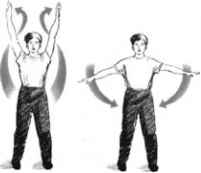
Relaxing the Shoulder’s With your feet shoulder width apart, slowly raise your arms as if lifting a ball. Breathe in with the upward movement. Turn your arms outwards and gently lower them back to the start, breathing out. Don’t hunch your shoulders or stiffen your arms. Make at least 30 complete circles with your arms.
Rotating the Hips
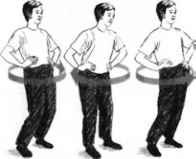
With your feet shoulder width apart, rest your hands on your hips. Slowly rotate your hips 30 times to the left and 30 times to the right. Keep your head gently upright. Let your abdomen soften and your lower back relax. Breathe naturally.
Strengthening the Knees
With your feet together, bend your knees and rest your hands just above them on your thighs. Slowly rotate your knees 30 times to the left and 30 times to the right. Try to keep the soles of your feet flat on the floor. Breathe naturally.
Once you have completed the warm-up exercises, you should undertake the practice of standing still in the following postures. Begin with the first posture, Wu Chi. Stand still in this relaxed position for at least 5 minutes a day, then gradually increase your standing time to 20 minutes.
This practice is a powerful self-treatment. As you become stable in the Wu Chi posture, your internal energy naturally seeks out accumulated tension and underlying imbalances throughout your system. The detailed instructions on pages 26-27and the advice on inner strength on pages 34-35 will help you.
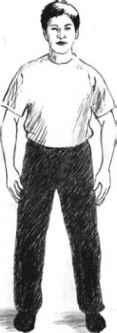
Stand still with your feet shoulder width apart. Relax your knees, belly and hips. Let your shoulders naturally ease downwards. Your arms hang loosely by your sides. Your fingers are slightly apart, naturally curved. Lower your chin a little and relax your neck. Look forwards and slightly downwards. Breathe calmly through your nose.
Wu Chi
Once you have accomplished the practice of standing in Wu Chi for up 20 minutes daily, do the same with the following sequence of positions. Always begin with your warm-ups and an initial 5 minutes of standing in Wu Chi.
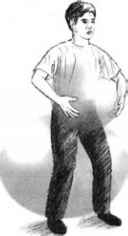
I. Holding the Belly With your feet shoulder width apart, slightly lower yourself as if resting your bottom on a large ball. Bring your hands in front of your lower abdomen as if gently resting a large ball against your belly – or as if you had a very large belly on which your hands are happily resting. Your fingers are gently spread apart and your shoulders completely relaxed.
2. Holding the Ball
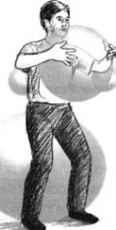
You continue to sit on an imaginary ball. Your arms form a comfortable circle as if holding a ball between your open palms and your chest. Your elbows sink a little lower than your hands and rest on small imaginary balloons under your arms. Keep your chest and shoulders completely relaxed.
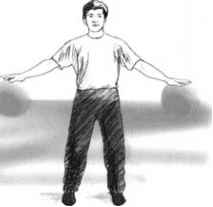
3. Extending to the Sides Keep the same body posture and extend your arms out to the sides, slightly in front of the line of your body. Relax your shoulders and slightly bend your elbows. You feel as if you are resting your hands on two balloons floating on water.
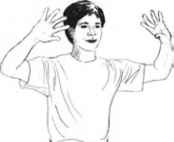
4. Opening Outwards Open your hands outwards as if pushing a large ball away from your face. Lower yourself a little further, making sure that your knees do not bend forwards over your toes.
Inner Practice
Standing Like a Tree harnesses your internal energy. Stand still, relax, let your central nervous system rebalance itself. Do not add other techniques, such as imagining the movement ofChi around the body or doing special breathing. These can create tension, obstruct the benefits of your practice and do internal harm. The inner work of Zhan Zhuang is uncontrived: be patient, relax, don t move. Your energy will work its wonders naturally
Sealing your Energy
At the end ofevery Chi Kung session, it is important to seal into your body the energy you have generated. This applies to the foundation postures and all the positions and movements in the rest of this book.
This position seals your energy into a reservoir just below your navel, known as the Sea of Chi. In Chinese, it is called the Tan Tien (pronounced “dan dyen”).
The Mind in your Practice
As you practice the standing postures and movements in this book, your mind is free to roam and experience the thoughts and feelings passing through it. Keep your eyes and ears open to whatever is happening. You can listen to music, even watch television as you practice – flowing music and non-violent channels are preferable. Remain upright, preserving your balance, and devote yourself to the inner relaxation of your being. Everything will flow from that in its own time.
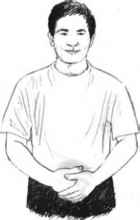
Stand in a relaxed, upright position with your feet shoulder width apart. Place your right palm over your lower abdomen. Then place your left hand comfortably on top of your right. You can lower your eyelids, but keep your eyes open to avoid losing your balance. Rest in this position for between two and five minutes. Breathe naturally.